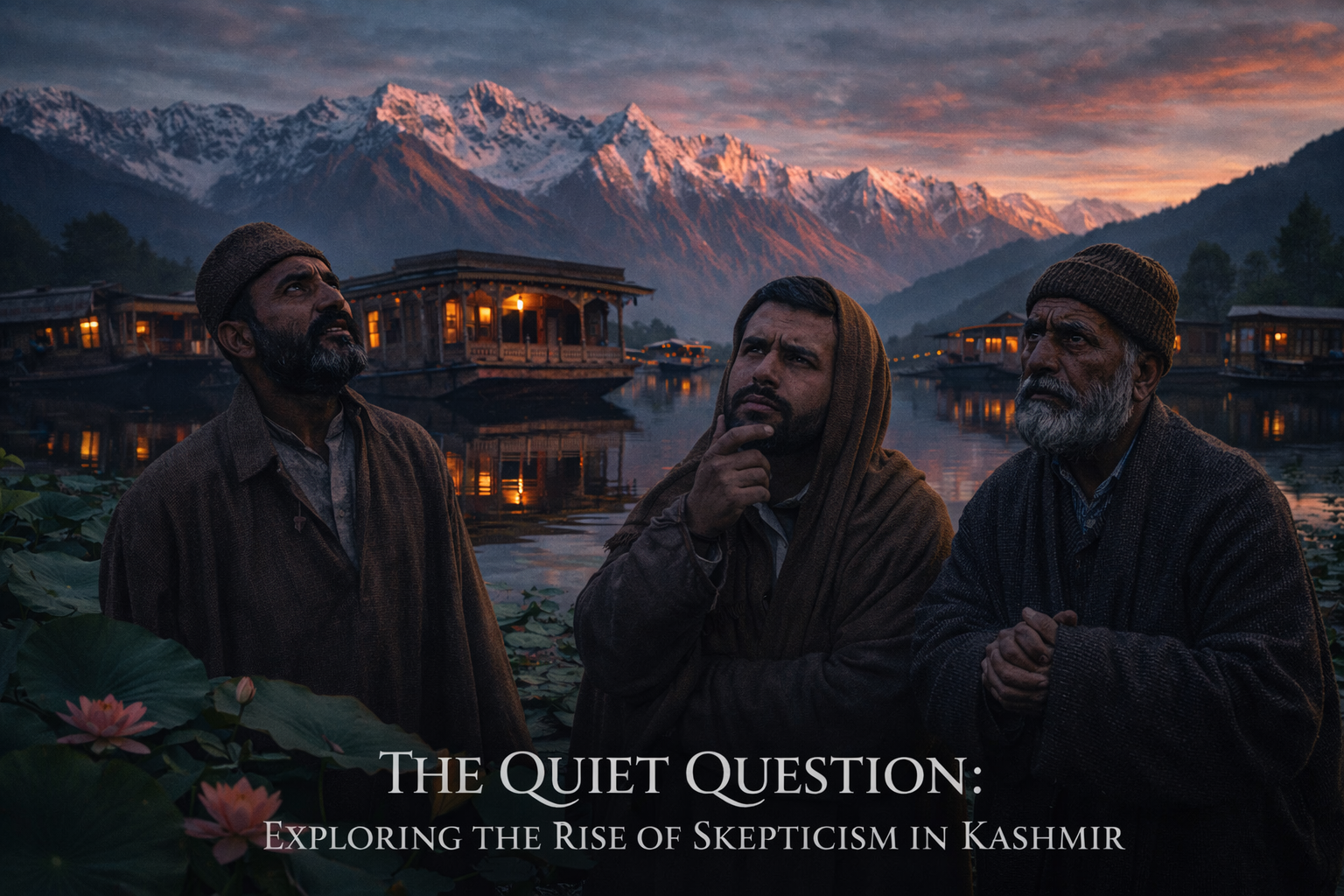

Kashmir has always been known as Pir Waer—the Garden of Saints. The call of the Azaan and the ringing of temple bells are the soundtrack of our valley. Faith here isn't just a belief; it is an identity.
But beneath the surface, a quiet shift is taking place. In university cafes, on anonymous online forums, and in hushed late-night conversations, a growing number of young Kashmiris are asking a dangerous question: "Why?"
The Internet and the Breaking of Silos
For centuries, knowledge in Kashmir flowed from the elder to the younger, from the pulpit to the congregation. Authority was absolute.
Then came the 4G revolution. Suddenly, a teenager in Anantnag had access to the same philosophical debates as a professor in Oxford. They watched debates between Christopher Hitchens and religious scholars. They read Nietzsche and Camus on their smartphones.
The internet broke the monopoly on truth. It allowed young minds to see that their doubts were not unique, but shared by millions globally. It created a virtual space where questions didn't result in scolding, but in discussion.
The Trauma of Conflict
Perhaps the deepest driver of this shift is the "Problem of Evil." Decades of conflict have left scars on every family. When a child sees violence, loss, and injustice on a daily basis, the traditional answers—"It is a test," or "It is fate"—sometimes stop working.
"I prayed every day for my brother to return safely," says one 24-year-old student from Srinagar (identity protected). "He didn't. That was the day the silence of the universe became too loud to ignore."
For many, skepticism is not a rejection of culture, but a response to trauma. It is an attempt to make sense of a world that often seems cruel and chaotic without divine intervention.
The "Closeted" Atheist
Unlike in the West, declaring oneself an atheist in Kashmir is not a simple social choice. It carries the risk of social ostracization.
This has led to a phenomenon of "double lives." Young people who perform rituals to please their parents, who fast during Ramadan to maintain social harmony, but who inwardly feel a void. They identify as "Cultural Muslims" or "Agnostics"—maintaining the community bond while privately stepping away from the theology.
A Crisis of Leadership
Many youth express disillusionment not with God, but with the "middlemen." The perceived hypocrisy of some religious figures, sectarian divides, and the use of religion for political gains have pushed thinking minds away from organized structures.
They see religion being used to divide rather than heal. In rejecting the institution, they often end up rejecting the faith itself.
The Path Forward: Dialogue, Not Judgment
The rise of skepticism in Kashmir is not a "threat" to be crushed. It is a reality to be understood. It signals a generation that values critical thinking and evidence.
Instead of silencing these voices, our society needs to create space for difficult conversations. Faith that cannot withstand a question is fragile. The intellectual history of Islam and Kashmiri Shaivism is rich with debate and inquiry. We need to revive that tradition of Ijtihad (independent reasoning).
Whether one finds peace in prayer or in philosophy, the ultimate goal remains the same: to find meaning in a complicated world. The youth of Kashmir are searching for truth. We should respect their journey, wherever it leads.