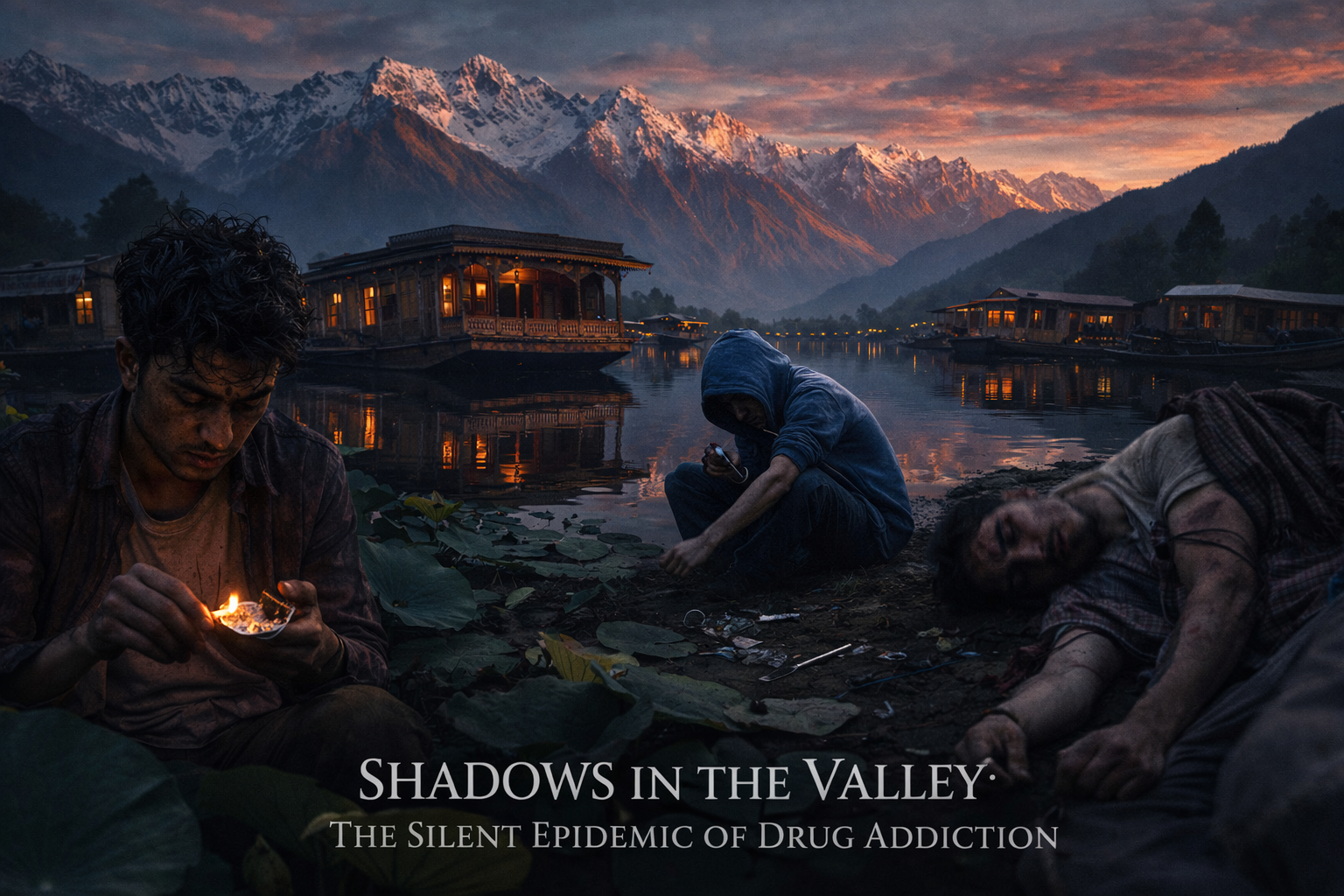

For thirty years, Kashmir counted its dead in encounters and crossfires. Today, we count them in overdoses.
A new enemy has breached the valley. It doesn't carry a gun; it comes in small foil packets and vials. It enters quiet homes in Srinagar, rural villages in Kupwara, and college campuses in Anantnag. The rise of drug addiction—specifically heroin—is not just a health crisis. It is an existential threat to the next generation of Kashmir.
The Scale of the Tragedy
The statistics are terrifying. According to a recent report by the Standing Committee on Social Justice and Empowerment, there are approximately 13.5 lakh drug users in Jammu and Kashmir.
But the most alarming figure is the shift towards hard drugs. Heroin use has skyrocketed. At the Institute of Mental Health and Neurosciences (IMHANS) in Srinagar, 95% of patients in the OPD are now seeking help for heroin addiction. A decade ago, this was unheard of.
- 10 Lakh+ estimated affected individuals.
- ₹88,000: The estimated monthly expenditure of a single heroin addict in Kashmir.
- 300% Increase in drug-related crimes (theft to fund addiction).
The Taboo: Women in the Shadows
Perhaps the most heartbreaking aspect of this crisis is the rising number of young women falling prey to addiction.
In a conservative society like Kashmir, a male addict is often taken to a doctor. A female addict is hidden. Families fear the stigma so deeply that they delay treatment until it is too late. We are seeing college girls, young professionals, and even homemakers trapped in this cycle.
"Addiction does not discriminate by gender. But our society does. A girl seeking help is seen as a stain on honor, so she suffers in silence until the silence kills her."
At IMHANS, doctors report a surge in female patients, often brought in under the cover of darkness, their identities shielded, their bodies ravaged by years of hidden abuse.
Why? The Roots of Despair
Why is paradise burning? The answer is a complex web of trauma and economics.
1. The Unemployment Void
As we discussed in our previous report on unemployment, 32% of urban youth are jobless. When a young man with a master's degree sits idle for five years, hopelessness sets in. Drugs become a momentary escape from the shame of being "unproductive."
2. Generational Trauma
Decades of conflict have left deep psychological scars. PTSD, anxiety, and depression are rampant. In the absence of robust mental health infrastructure, self-medication becomes the default coping mechanism.
3. Easy Availability
Kashmir's geography places it on transit routes for narcotics. The sheer availability of high-purity heroin in villages and cities alike has made accessibility dangerously easy.
The Way Out: Compassion Over Judgment
We cannot arrest our way out of this crisis. A drug addict is not a criminal; they are a victim of a disease.
Rehabilitation, not Incarceration: We need more
de-addiction centers, not just in Srinagar, but in every district.
Breaking the Silence: Religious leaders,
parents, and teachers must speak about drugs in mosques and
classrooms—not to condemn, but to educate.
Sports & Engagement:
We need to give youth an alternative dopamine rush. Stadiums,
libraries, and hiking clubs (like Friend Circle) are the first line of
defense.
To the youth reading this:
Your life is worth more than a momentary high. If you are struggling, reach out. There is no shame in asking for help. The true shame lies in giving up on yourself.
Kashmir needs you. Not numb, but alive.